User Experience Research and Design for my project
User Experience Design (UXD) is a cornerstone of successful web development, ensuring that a digital product is not only functional but also user-friendly and engaging.
The success of any web-based project relies heavily on the user’s ability to interact seamlessly with the platform.
A well-executed UXD process ensures that the goals of the project align with user needs, promotes accessibility and inclusivity for a diverse audience, optimizes navigation and overall usability, and enhances engagement by fostering user satisfaction and encouraging repeat visits.
Research context
This research aims to identify the needs of people traveling to Mauritius who are seeking an authentic island experience. The project is designed to highlight the beauty and peacefulness of local life in Mauritius. By showcasing this lifestyle, the goal is to promote the island’s rich historical and cultural background while providing travelers with a unique perspective on what makes Mauritius special.
The project seeks to not only bring recognition to unsung local heroes but also promote their contributions to the cultural and culinary heritage of Mauritius. By presenting an authentic view of Mauritian life, the website will foster deeper connections between travelers and the island’s roots. This exposure will encourage tourism by facilitating access for travelers and also inspire visitors to appreciate and preserve the island’s traditions.
Research Objective
What do I want to learn?
- How do people currently plan their trips to Mauritius?
- What types of content do travelers want to see on a website when visiting a country or island?
- Which website features could help tourists maximize their time on the island?
Assumptions
- Travelers to Mauritius are food enthusiasts.
- Tourists enjoy supporting local entrepreneurs.
- Visitors are willing to explore the island to discover authentic local food spots.
- Most tourists focus on hotels and restaurants that don’t always offer authentic Mauritian cuisine.
Hypotheses
- This project will enable users to research and locate local food spots in Mauritius.
- Travelers will be able to plan their itineraries based on the type of food they wish to explore.
- The project will increase interest in visiting Mauritius by showcasing the island’s authentic lifestyle.
Target audience
- Primary audience: Travelers and potential tourists planning trips to Mauritius.
- Secondary audience: Local residents of Mauritius who want to share or promote their culture and businesses.
Existing evidence
According to ‘Statistics Mauritius’, approximately 997,290 tourists visited Mauritius in 2022, and this number increased to around 1,295,410 in 2023.
More details of the ‘Statistic Mauritius’ can be found here
Methodology
This study adopts a qualitative methodology to gain a deeper understanding of the experiences and preferences of tourists traveling to Mauritius. A qualitative approach will provide insights into the motivations, behaviors, and expectations of the target audience.
Participants
Participants will include:
- People who have never traveled to Mauritius.
- Tourists who have visited Mauritius.
- Local residents who can provide insights into authentic Mauritian life and cuisine.
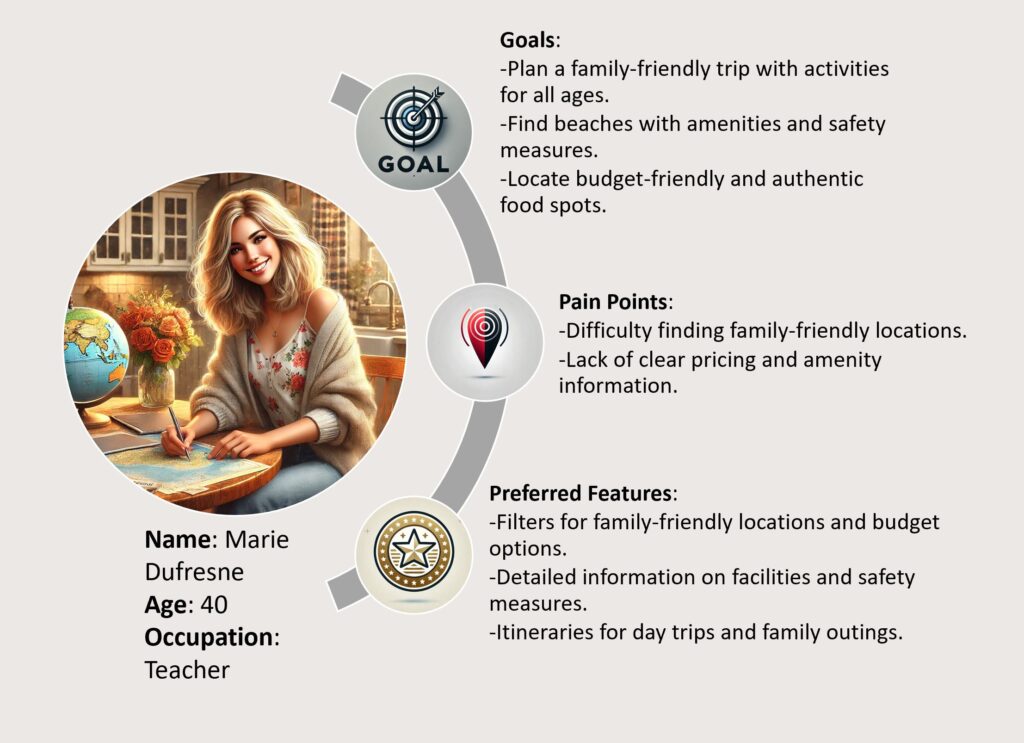
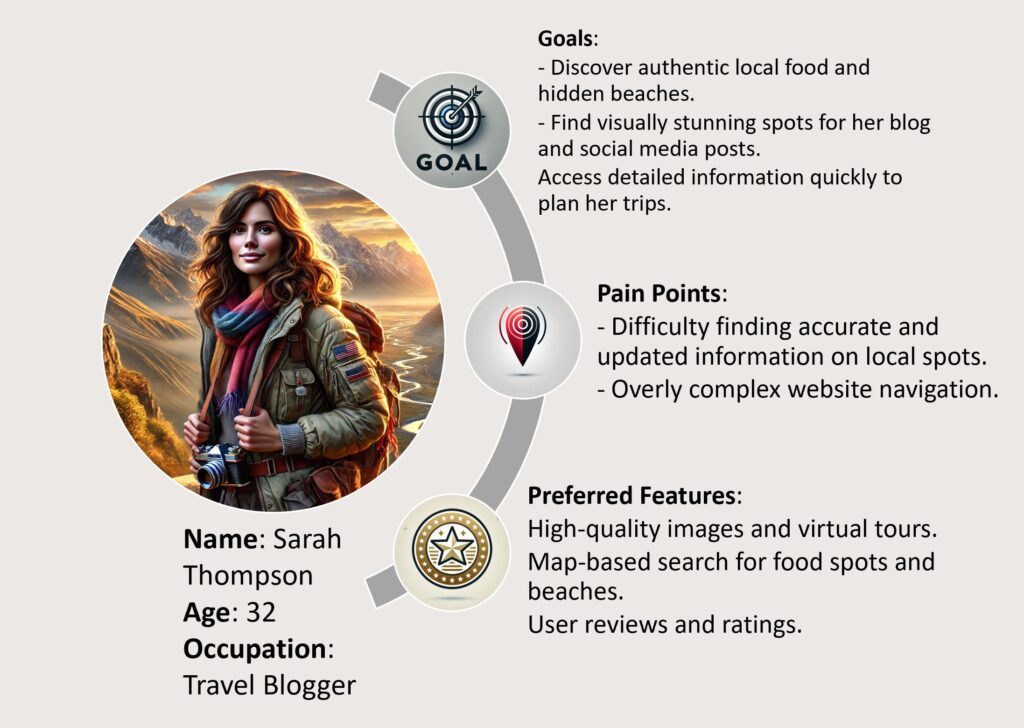
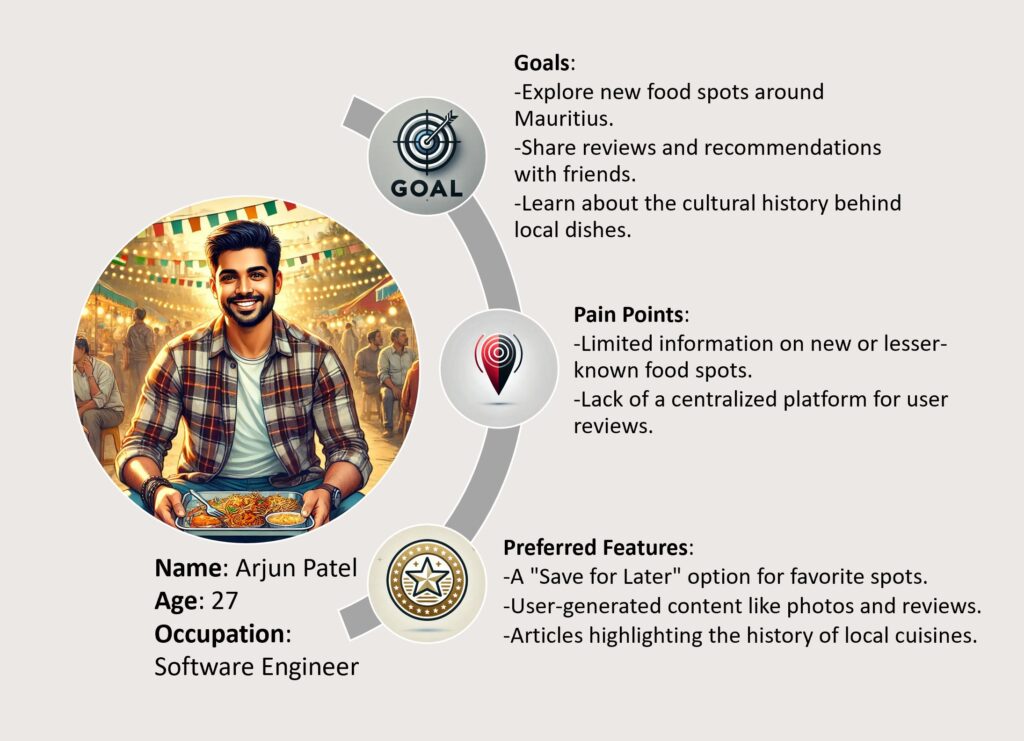
User personas
The user personas I created are so as I can try and represent my potential users. This will allow me to remain focus on the assumptions and hypothesis created.
Data Collection Methods
- Interviews: Conduct in-depth interviews with tourists and locals to gather detailed insights on their expectations of the website.
- Focus Groups: Engage groups of travelers to explore their preferences and expectations for a travel-planning website.
- Observation: Analyze existing travel websites to identify gaps and opportunities for improvement.
Research Implementation Plan
The research will be conducted concurrently with the development of the major project, making it an ongoing process. The final project is due on 26/09/2025. Below is the estimated timeline for research implementation:
1. Survey (deadline: 20/01/2025)
I will create a survey form with the help of Google form and I will send it to my friend and acquaintances to fill out. The goal of this survey is to gather information about the content that potential users may want to see on the website. The survey will help me gather valuable qualitative insight from various users. The survey will help me reach people in Mauritius easily so as to have an insight on the locals point of view.
The most important part of the survey will be to compiling the data so as to be able to find meaning in the qualitative and quantitative data collected.
Below is a survey that will be send to as many people as possible (minimum 25) in order to have an insight on the users interest and expectation.
2. Card sorting (deadline: 20/02/2025)
Card sorting will allow me to help me organize my content by giving me insight on how users organize and categorize their information and content. The information that I will gather will allow me to finalize the layout and maybe the color scheme.
“Card sorting is a useful method when creating or reworking your information architecture, navigational structures and/or content organization.”
–Experience Management
3. Prototyping (deadline: 25/03/2025)
With the help of ‘Figma’ I will create a prototype of the website according to the insight gather from the survey and the card sorting. A prototype will allow me to show the website to potential users and allow me for further research. For this step I will have to dive into the world of ‘Figma’ so as to be able to deliver the best prototype.
4. Moderated User Testing (deadline: 14/04/2025)
Carrying a moderated user testing will require me to observe participant when they are using the prototype. During the observation, I will observe their reaction and their interaction with the website. This provides me with the insight about the users feeling and behavior. A well carried out moderated user testing will provide valuable qualitative data on the usability of the website. I will need to record the user’s experience when they are interacting with the website. I will also be able to guide and question the users.
5. Designing/Wireframing (deadline: 23/07/2025)
With the data collected from the different research tool I mentioned above, I will proceed to design and build my website accordingly. The valuable insight that I gathered will allow me to build the website with the users in mind.
6. Tree testing (deadline: 12/08/2025)
I will carry out a tree testing to allow me to focus on the efficiency of the layout. I will allocate specific task for my users and I will observe how they navigate the website and what they expect to see upon clicking any element found on the website. This technique will also allow me to have a more in-depth point of view on the hierarchy of my content.
7. Compilation (deadline: 24/08/2025)
With all the information gathered a final design would be generated. This will include every aspect of the website, from the logo to the color scheme.
Conclusion
This research will lay the foundation for designing a user-centric website that showcases the best of Mauritius. By understanding user preferences, improving usability, the website aims to provide an engaging and authentic experience. Future steps involve further refinement through user feedback and continuous updates to maintain relevance and usability. The website will be designed to be responsive, the website will provide a seamless experience across devices, ensuring accessibility and usability for all visitors.